How CarbinWatcher Built a Predictive Sustainability Platform for Waste Sorting in 26 Hours
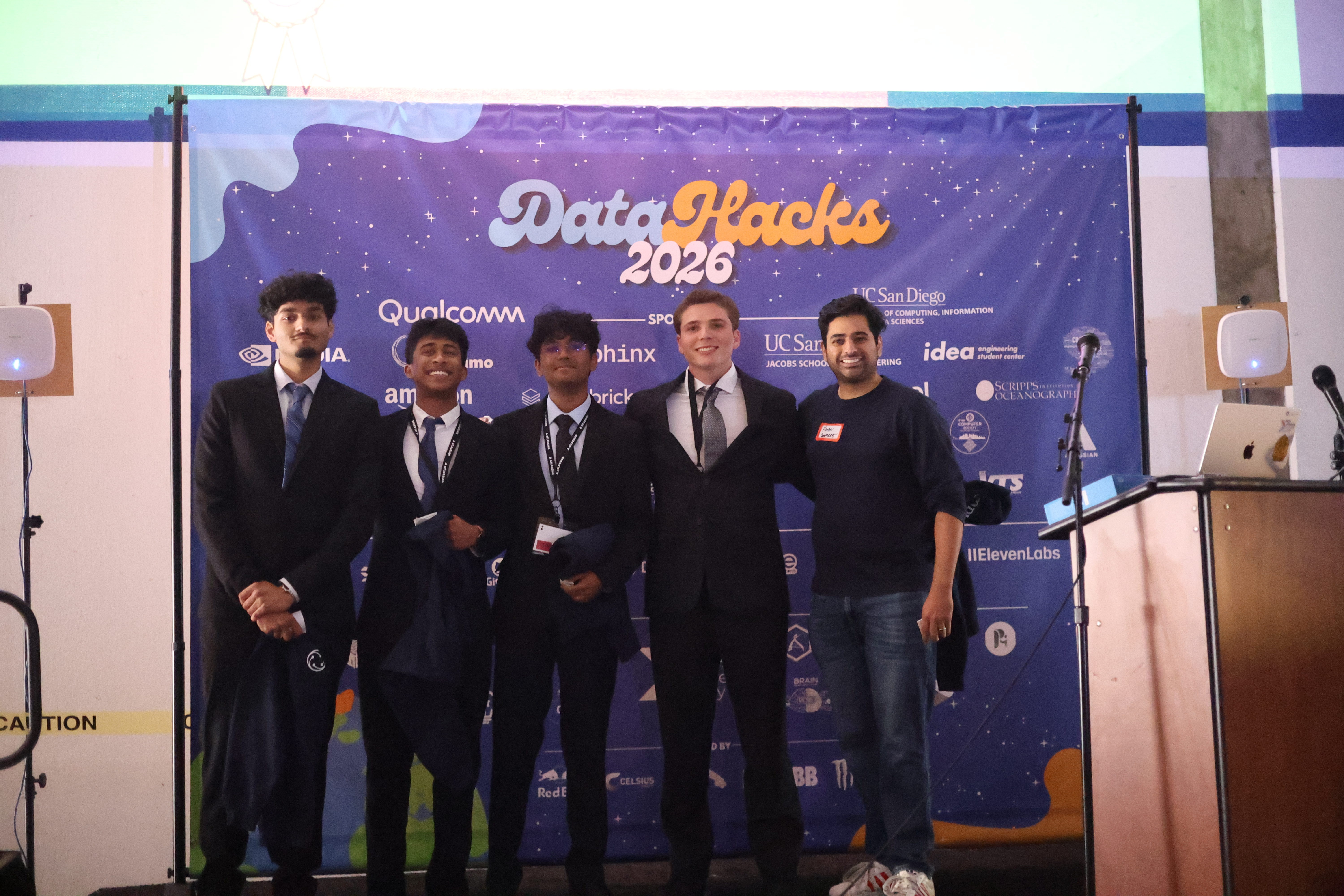
This past weekend, Impulse AI was proud to sponsor DataHacks 2026, hosted by UCSD's Data Science Student Society. After 26 hours of building, we walked away genuinely impressed, not just by the polish of the work, but by the ambition of the problems teams chose to solve.
Third place in the Impulse AI challenge went to CarbinWatcher, a team that took on a problem most people contribute to every day without realizing it: waste ends up in the wrong bin because people are forced to guess.
Here's their story.
The Problem: 270 Billion Pounds of Guesswork
US households generate roughly 270 billion pounds of waste a year that gets sorted incorrectly, and millions of metric tons of CO₂ emissions per year are attributable directly to household misclassification. Recycling streams get contaminated. Compostable material ends up in landfills. Emissions accumulate that nobody asked for.
The issue isn't bad intent. People care, they just don't know which bin the item belongs in. Rules vary by city, by item, and by material, and most of us don't have time to look it up at the bin. So we guess, and many of us guess wrong.
CarbinWatcher set out to remove the guess.
The Solution: An Intelligent Waste Station
CarbinWatcher turns an ordinary bin into a real-time classification system. The setup is a webcam connected to an Arduino Q that watches items before they're thrown away. When someone holds up a piece of waste, the system:
Runs a YOLOv8 nano classifier on the edge, trained on over 17,000 images, to identify the object locally for privacy
Cross-references the prediction against local disposal regulations
Uses MiDaS monocular depth estimation to measure the volume of waste going into the bin
Tells the user whether the item belongs in trash, recycling, or compost
Every disposal becomes data. It streams from the Arduino into AWS IoT Core, fans out to DynamoDB for the live dashboard and S3 for analytics, and lands in Databricks for an ETL pipeline that computes emissions and waste metrics.
The station works just as well in homes as it does in offices, campuses, and public spaces.
How They Built It, With Impulse at the Core
CarbinWatcher used Impulse to train predictive sustainability models on top of the device data. Instead of just classifying the item in front of you, the system projects what smarter sorting habits would add up to across households, neighborhoods, and cities. Their dashboard shows a live San Diego-scale projection of CO₂ reductions and waste diversion built directly from the model's output.
The notable thing here: the team shipped a working predictive layer in a little over a day without a dedicated ML engineer and without building model infrastructure from scratch. Impulse handled the data prep, model selection, training, and deployment, which freed them up to spend their hackathon hours on the harder parts of the product.
If you have data and a problem worth solving, Impulse handles the data prep, model selection, training, and deployment, so you can focus on what your tool actually does.
The Outcome: A Full Pipeline and Third Place
By the end of the hackathon, CarbinWatcher had every layer live and connected. The edge device was classifying items in real time. Databricks was running the ETL pipeline. The Impulse-trained models were projecting city-level impact. And the Next.js dashboard was showing all of it update live, down to the kilograms and cubic centimeters of an apple going into the bin.
A working end-to-end system, built in a weekend, took third place in the Impulse AI challenge at DataHacks 2026.
Congratulations to the Team
To Daniel Mathews, Karsten Lowe, Suvanjan Sitaula, and Omkar Guru, congratulations from all of us at Impulse. You took on a problem most people contribute to every day without realizing it and built something that could meaningfully change behavior at the moment it matters. We can't wait to see where you take this next.