How TrailKarma Built a Predictive Wildlife Safety Model for Hikers in 24 Hours
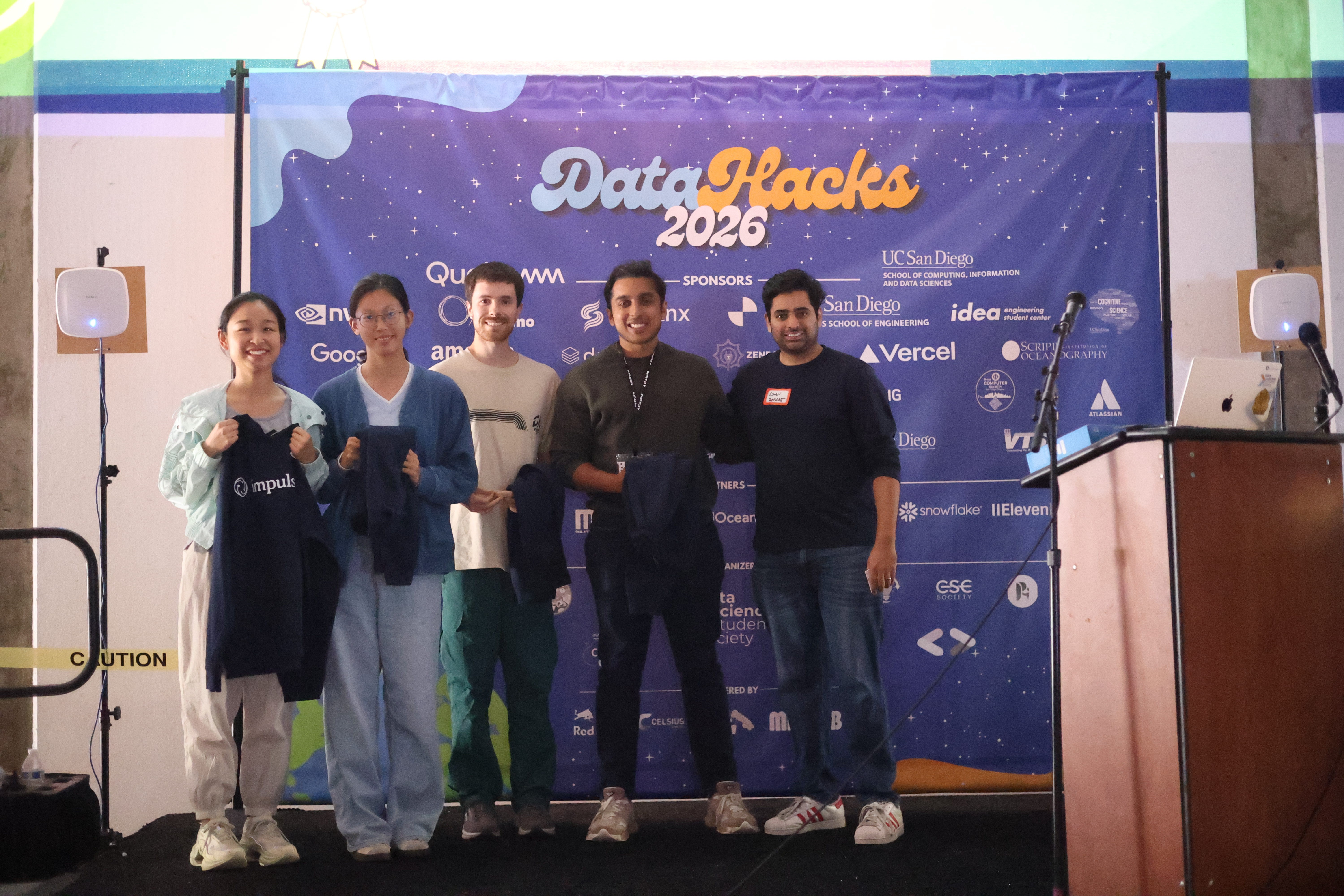
This past weekend, Impulse AI was proud to sponsor DataHacks 2026, hosted by UCSD's Data Science Student Society. After 26 hours of building, we walked away genuinely impressed, not just by the polish of the work, but by the ambition of the problems teams chose to solve.
Second place in the Impulse AI challenge went to TrailKarma, a team whose project started with a real near-miss on the Pacific Crest Trail and ended with a working hiking app that combines offline mesh networking with a predictive wildlife model.
Here's their story.
The Problem: The Trail Knows, But the Trail Can't Tell You
One of TrailKarma's teammates was hiking the PCT when everything went wrong on day 3. He hiked 40km solo, nearly stepped on a rattlesnake, and his safety app locked him out because there was no signal. He detoured 2km looking for internet, found none, and eventually ran into hikers from day 1 who lent him an emergency satellite SMS. He quit the trail after that.
What stuck with him wasn't the snake. It was that the hikers he'd passed earlier already had the information he needed, and there was no way to get it from their phones to his.
The issue isn't that hikers don't share what they see. It's that the channels for sharing are thin: a Google Spreadsheet here, a forum thread there, a comment overheard at camp and forgotten by the next morning. Even the people who do log information often can't remember exactly where they saw it.
Rattlesnake sightings, washed-out bridges, dry water caches, all of it lives in fragmented notes, scattered DMs, and the memories of people you'll never meet. Many of those hazards are already known by someone on the trail that day. The goal isn't to put more information online. It's to move information between people who are already passing each other, even when they have no signal.
TrailKarma set out to build that layer.
The Solution: An Offline-First Hiking App With a Predictive Safety Model
TrailKarma is an offline-first hiking app with three layers that work together:
Local logging. Hazards, water sources, and wildlife sightings are logged to a local database. GPS is sampled continuously and snapped to trail segments. Nothing hits the cloud until you're back online.
Bluetooth mesh. When you pass another hiker with TrailKarma installed, your phones discover each other over Bluetooth Low Energy and exchange missing reports automatically. A washed-out bridge logged 5 miles back reaches you before you ever see signal, relayed forward by every hiker in between.
Cloud sync. When you reach a trailhead, everything syncs to Databricks with H3 hexagonal indexing for fast spatial queries.
On top of that, the team added the feature that made the project stand out: a predictive wildlife safety model.
How They Built It, With Impulse at the Core
TrailKarma used Impulse to train a model that predicts where dangerous wildlife is likely to be encountered on a given trail. They fed it historical data on dangerous animal encounters across species, locations, times of day, seasons, and environmental conditions. Once deployed, the model takes a hiker's current trail, location, and time, and returns the species they're most likely to encounter and where along the route the risk is highest. That's the information their teammate needed on day 3 and didn't have.
The notable thing here: the team shipped a working predictive safety layer in 24 hours without a dedicated ML engineer and without building model infrastructure from scratch. Impulse handled the data prep, model selection, training, and deployment, which freed them up to spend their hackathon hours on the harder parts of the product, the Bluetooth mesh, the Solana reward flow, and an offline-first architecture that has to work when nothing else does.
If you have data and a problem worth solving, Impulse handles the data prep, model selection, training, and deployment, so you can focus on what your tool actually does.
The Outcome: A Live, Connected App and Second Place
By the end of the hackathon, TrailKarma had every layer live and connected. Two phones could walk past each other and sync reports without touching a screen. The Databricks backend was serving real H3-indexed spatial queries. And the predictive wildlife model was running on real trail data.
A working end-to-end product, built in a weekend, took second place in the Impulse AI challenge at DataHacks 2026.
Congratulations to the Team
To Suraj Ranganath, Aldan Creo, Edith Gu, and Qianqian Zhang, congratulations from all of us at Impulse. You turned a bad day on the PCT into a project that could genuinely keep people safer on the trail. We can't wait to see where you take this next.