How We Build Production ML Models in Under 5 Minutes without Coding
How We Build Production ML Models in Under 5 Minutes without Coding
The Starting Point: Kaggle Spaceship Titanic
We're using the Kaggle Spaceship Titanic competition dataset. The task: predict which passengers were transported to another dimension.
Standard tabular ML problem. Binary classification. The kind of model data scientists build dozens of times per year.
Traditional approach: 2-3 weeks of work across data scientists, ML engineers, and DevOps.
Our approach: Describe the problem, upload data, done.
Automated Data Quality Analysis
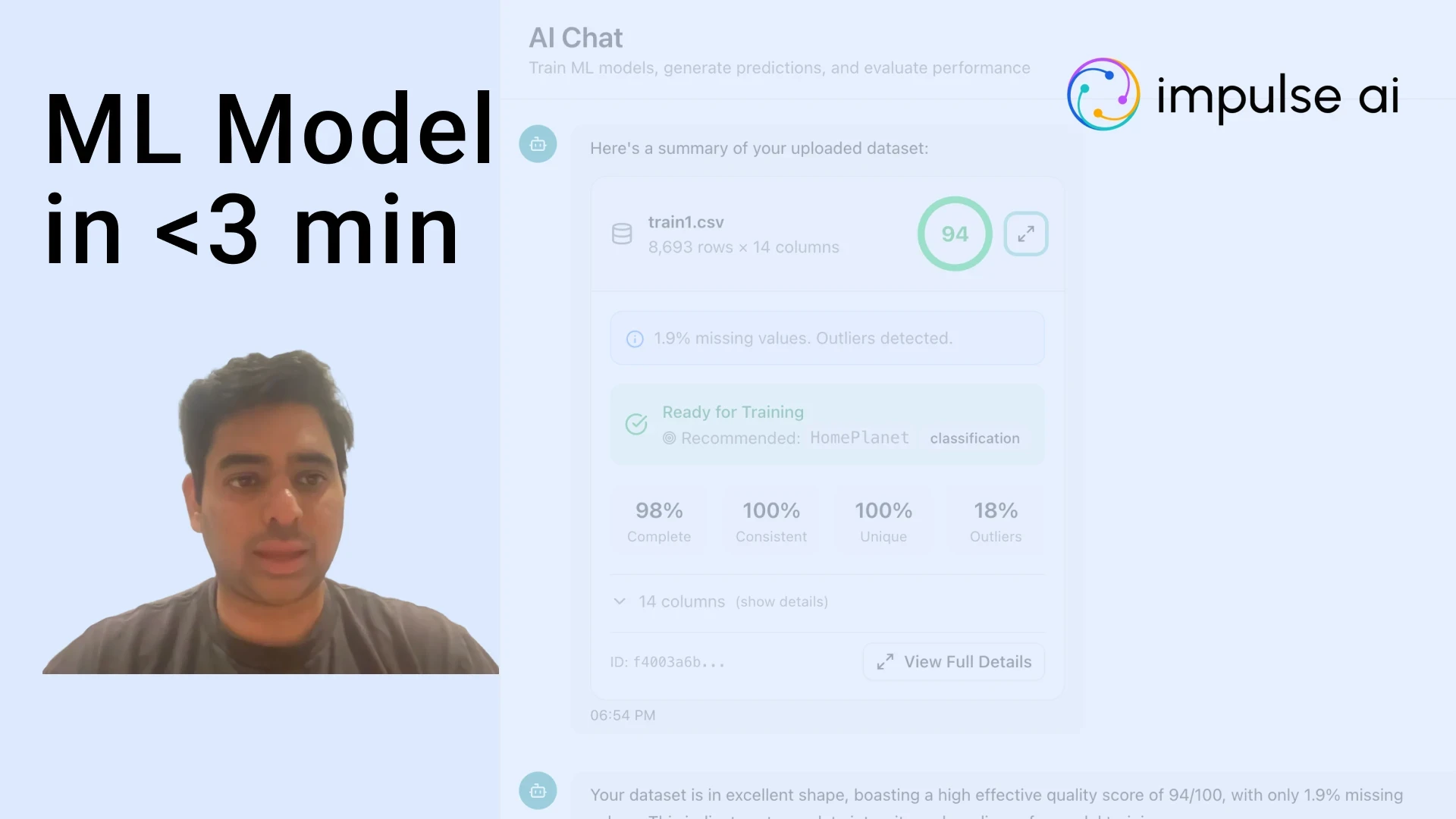
Upload the training set. The agent immediately runs exploratory data analysis.
Data Quality Score: 94/100
The system evaluates completeness, consistency, missing values, distributions, correlations, and flags issues with severity.
This isn't a black box score. You see every column's statistics, distribution visualizations, and specific data quality issues with recommended fixes.
Why this matters: Most ML projects fail because of data quality problems discovered after training. We catch them before wasting compute.
Training Without Configuration
The prompt: "Train a model to predict who was transported."
That's it. No hyperparameter tuning. No model architecture selection. No feature engineering specification.
The agent asks one question: "Do you have a validation dataset?"
Upload it. The agent validates schema, confirms no data leakage, and begins autonomous training.
What happens under the hood:
Tests multiple model architectures (XGBoost, LightGBM, neural networks)
Generates feature engineering candidates
Runs cross-validation
Detects and prevents data leakage
Time elapsed: <3 minutes
Model Performance and Feature Importance
Training completes. You get metrics (accuracy, F1 score) and feature importance rankings.
Top feature: CryoSleep status. If you're a domain expert, this validates the model makes sense. If it flagged something nonsensical, you'd know the model learned a spurious correlation.
Generating Predictions
Click "Generate predictions." The model runs inference on the test set.
Three deployment options:
Download predictions as CSV (batch processing)
Use our API endpoint (real-time inference)
Use the UI for one-off predictions
Most AutoML tools stop at "here's a trained model." We give you a production system.
From Demo to Production: Our Kaggle Validation
The Spaceship Titanic demo is instructive. But here's the real validation.
Kaggle Playground Series S5E11: "Predicting Loan Payback"
We entered our autonomous agent. Zero human intervention. Competing against 31,791 participants—professional ML engineers from Google, Meta, top universities.
Result: Rank 782 (Top 2.5%)
[Verification: https://www.kaggle.com/competitions/playground-series-s5e11/leaderboard - search "Eshan"]
This wasn't possible 18 months ago. LLM capabilities crossed a threshold in 2024-2025 where autonomous agents can match human ML engineering for standard tabular tasks.
What this proves:
The agent produces competitive-quality models
Autonomous ML engineering is no longer theoretical
For 80% of enterprise ML workloads (tabular data), you don't need a $200K MLE
What This Actually Means
Traditional ML pipeline: 3-6 weeks, 3 people, time consuming data analysis, feature engineering, model tuning, deployment, and monitoring setup.
Impulse pipeline: <1 hour, zero ML expertise required.
We're not replacing data scientists for genuinely hard problems—novel architectures, research-level work, custom loss functions.
We're replacing the 80% of requests for the same tabular models they've built 100 times: churn prediction, fraud detection, demand forecasting, lead scoring.
The models that sit on backlogs for months because there aren't enough MLEs to build them.
About Impulse AI
Impulse AI is building an autonomous machine learning engineer that turns data into production models from a simple prompt. Founded in 2025 and based in California, the company enables teams to build, deploy, and monitor expert-level ML models without code or specialized ML expertise. For more information, visit https://www.impulselabs.ai.